

Whether an organization has a strong learning culture or a weak information-sharing system can make or break employee, leader, and customer experiences alike. Working in an environment that is conducive to learning is imperative to retaining employees who build their capabilities and aid in growing the business. In fact, 87% of employee learners reported their educational activities helped them feel more capable and well-rounded.
“Learning culture” can be interpreted two ways, both equally important yet one more applicable to the actual learning employees partake in and how they can best do so. Learnupon.com describes a learning culture as putting a “strong emphasis on encouraging members to understand [the organization’s] values, practices, beliefs, skill sets and conventions.” A learning culture at a business in this sense prioritizes the organization’s ideals and goals in a way that team members can comprehend and work to further perpetuate in their respective positions.
On the other hand, a learning culture is also a term used to describe an environment in which learning is optimized, such as during meetings and other places where important information is relayed by leaders to teams. A strong learning culture in this sense is imperative to successful professional development and skill expansion. Let’s explore where this level of learning culture stands in an organization.
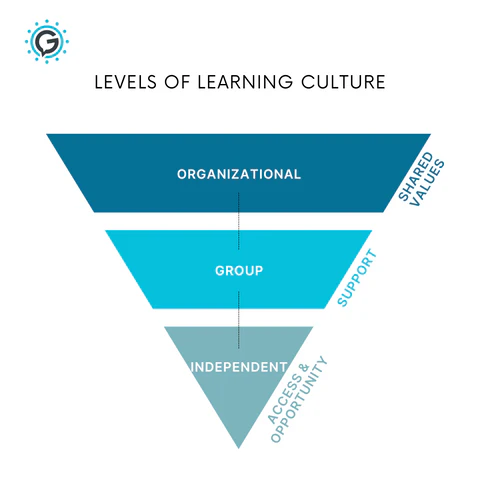
At an organizational level, learning culture looks like a team learning and applying a shared mission while working with the same values and processes.
At a group or team level, a positive learning culture looks like having learning resources, supporting each other in learning new things, and providing feedback to those who teach and to those who learn.
At the individual employee or independent level, a healthy learning culture looks like plenty of opportunities to learn and apply knowledge, equal and easy access to learning materials, and adequate time to learn and reflect. This is where personal growth at work snowballs into substantial company progress. When everyone learns and levels up their skills, everyone grows.
94% of employees say that investment in training and development is one of the major reasons they would decide to stay in a role for longer.
It is obvious that employees need consistent learning to feel satisfied a their job, yet creating a learning culture at work is important to the development of many other aspects of employees’ jobs and experiences at a company.
Having a culture of learning at work encourages team members to be more open, flexible and adaptable, especially as they hone their soft skills.
A learning culture also allows employees to develop natural curiosity which is an important foundation for successful collaboration and finding more passion for your work.
Employees have a chance to develop their expertise via skills development, which should be a priority in a healthy learning environment.
With a culture of learning also comes clarity and a better understanding of material and information which allows for teams to become more efficient, more independent, and less susceptible to imposter syndrome.
Employees become more agile and discover how best they learn, how they can continue to learn, and how to optimize critical thinking to find solutions.
Committing to a strong learning culture at work adds learning to your organization’s core values which communicates the business in a different light to new employees and encourages current employees to stay with the company.
With a consistent commitment to optimized learning, a better customer experience is a key result. Employees learn what skills, processes and techniques are missing from their toolkit which they can then integrate into their customer care work. Similarly, when learning culture on the foundational organizational level is strong, teams can create crystal clear definitions and imagery for customers or potential customers who are interested in the business. A team that is constantly learning, evolving and adjusting with the customer in mind will always create more value for customers.
A learning culture, especially in the team or group sense, creates a more cohesive team that is also more interdependent. This allows for great opportunity for unique problem-solving sessions, incredible innovation and knowledge sharing for the betterment of projects.
Learning culture is a prerequisite for growth culture. When organizations, teams and individuals work in a positive learning environment, company growth increases. Teams perform better, employees become more engaged and therefore more productive, all leading to higher ROI and long-term success. Plus, with higher employee retention, a well-oiled team can bring results that multiply due to a strong basis and understanding of values, continuous learning and support.

How do you know if you’re a part of a positive learning culture?
Sometimes the culture at work feels like a learning culture, yet it is actually ineffective and provides employees, customers, and managers minimal value.
For example, a teaching culture is the opposite of a learning culture but difficult to pinpoint without knowing what a learning culture looks like. Teaching culture is passive and submissive while learning culture is dynamic and resilient. Teaching culture expects members to be compliant and for material and processes to stay fixed, while learning culture is inherently supportive and encourages growth. If learning at work feels uninspired and stagnant, you may be stuck in a teaching culture where learning goes one way: leaders to employees with no feedback or learning for leaders. In a learning environment, every member of the team continuously learns through collaboration, feedback, and changes in processes.
It is also common for workplaces to get caught up in compliance culture. Compliance culture prioritizes knowledge and its use, yet it lacks in application, integration, and communication. If a team learns in a compliant culture, they tend to bank information to use it only when necessary and they fail to apply their knowledge when making important decisions. Planning and assessment are usually minimal, therefore information is usually disseminated only when prescribed and necessary. There is a huge lack of feedback and communication in compliance culture, due to lack of confidence in employees, lack of team support, demotivated employees, and unengaging educational activities.
Your team can shift your compliant culture to a positive learning culture by challenging team members to inform their decisions with the knowledge they learn, setting aside time to analyze the knowledge they gain and ask for and give feedback accordingly, and incorporating new information into every department and group of the workplace to help solidify that first organizational level of learning culture. Communication is imperative so that leaders know when the culture has successfully changed for the better and how they can better support their employees in their learning at work.
Here are some solutions to typical issues teams might find when cultivating a learning environment with remote team members:
Creating and sustaining a learning environment and following the tips above are realistic for any office or in-personal workplace, yet creating a strong and cohesive culture of learning online or in a hybrid environment can be particularly tricky.